Notices and delistings
Missed the withdrawal deadline on a delisted token?
The deadline passing doesn't always mean the tokens are gone. Find out which of three situations you're in, then read what your platform actually promises.
Sometimes, yes. What happens after the deadline depends on what the platform wrote into its own rules: some convert unclaimed delisted tokens into a stablecoin and credit your account, some run a manual request process that costs a fee, and some say nothing at all.
Before you write to support, do one thing. Log in and find out which of those situations you are actually in.
Find the balance first
Open the asset list in the app or on the web and type the ticker into its search box. If nothing shows, switch off any "hide small balances" toggle and try again. What you see will usually fall into one of three cases:
- Case AThe tokens are still there; withdrawal is greyed out
The balance hasn't been touched. The platform simply hasn't processed it yet, so its written policy decides what comes next.
- Case BThe tokens are gone and a stablecoin appeared
Your transaction history should show a conversion line. Match it against the notice that announced the conversion.
- Case CThe tokens are gone and nothing replaced them
Screenshot the asset page with a visible timestamp, dig out anything showing the balance before the deadline, and open a ticket.
What three exchanges actually say
There's no industry standard here. The three below were checked against their own help-centre pages in September 2026, and between them they cover the three approaches you are likely to meet.
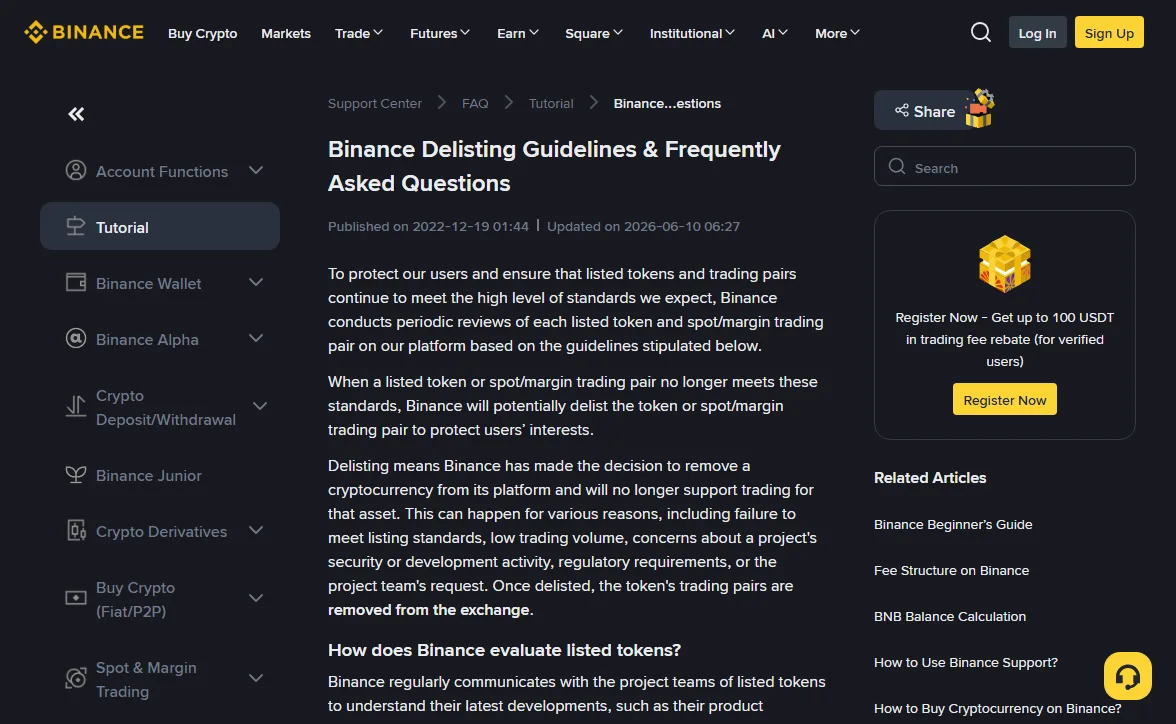
Binance: automatic conversion, maybe. The Binance Delisting Guidelines & FAQ (updated 2026-07-03 according to the page) says withdrawals usually cease two months after a token's delisting date, and that after that point delisted tokens may be converted into stablecoins on users' behalf and credited to their accounts. A separate notification comes before any conversion, and the page is explicit that conversion is not guaranteed. There is no application step: you wait for the notice.
BTSE: recovery on request, assessed case by case. Its token delisting article says the team can attempt to recover funds you did not withdraw in time. It first checks whether recovery is feasible at all; if it is, the attempt still isn't guaranteed. A fee based on the recovered funds is taken from your wallet, recovery is only tried within two months after withdrawals end, and BTSE won't share progress updates until the process is finished. Silence for weeks is part of the design, not a rejection.
MAX: a paid, written request. The Taiwanese exchange's help article on overdue delisted balances (in Chinese) tells users to email support at [email protected]. It charges NT$150 or 5 USDT, starts once the documents check out and the fee has arrived, issues an invoice, and aims to finish requests made in one month by the end of the following month.
| Platform | You apply? | Cost to you | Time window | Guaranteed? |
|---|---|---|---|---|
| Binance | No, a notice comes first | Conversion at a price the platform sets | After withdrawals cease | No |
| BTSE | Yes, via support | Fee based on funds recovered | Up to 2 months after withdrawals end | No |
| MAX | Yes, by email | NT$150 or 5 USDT | Done by end of the month after you apply | Not stated |
If your exchange isn't one of these, search its help centre for "delist" together with "deadline" or "after". Nothing there? Ask support directly how delisted tokens are handled after the withdrawal deadline and whether a request process exists, and ask for the answer in writing, not a one-line chat reply.
If you received a stablecoin instead
There is nothing left to recover. The job now is checking, not arguing.
-
Pair the notice with the ledger entry
Binance says it notifies users before converting, so an inbox message or announcement should exist. Check the token amount and which stablecoin you received.
-
Accept that the price wasn't yours to pick
By this stage the token usually has no trading pair left, and the platform sets the conversion price under its own rules. A disappointing number isn't an accounting error.
-
Move it like any other balance
The stablecoin can be withdrawn normally. If the platform is scaling back in your region as well, don't leave it sitting there for another cycle.
Only open a ticket if the amount is clearly off, or if the same conversion notice covered your token and you received nothing. Attach the ledger screenshot, the notice link and your pre-deadline balance evidence.
If you have to file a request
Manual processes want documents, time and money, and they promise nothing. Having these ready avoids a round of "please also send…":
- Account identifiers: your UID plus the email or phone number on the account, matching the ticket;
- Balance evidence: a current screenshot and something from before the deadline, such as a screenshot or an exported funding history;
- The delisting notice URL, so support doesn't have to guess which round it was;
- A receiving address that still works: check on the receiving side's deposit page that it supports this token on the network you'll use;
- Funds for the fee: MAX takes TWD or USDT, BTSE deducts from your wallet.
Which records deserve keeping long term is covered in which transfer records are worth keeping. An account that is already past a deadline can lose more functions without much warning, so export what you can now.
Whether the chain is alive matters more than whether support agrees
That is why BTSE puts "assess feasibility" first. Sending your tokens needs a chain that still produces blocks and a platform wallet that can still sign a transaction on it. If the project has been abandoned, its nodes switched off or its token migrated to a new contract, the old tokens may be technically impossible to move. "Not feasible" in that case is an honest answer.
Run the numbers before you pay
Take a cautious value for the balance, subtract the service fee, then subtract the token's withdrawal fee. If the result is negative or close to zero, a request only buys you a paper trail.
With MAX's 5 USDT fee as the yardstick: suppose your leftover tokens are worth about 3 USDT today. You would pay more than you get back. At 200 USDT the fee is small change and the email is worth sending this week. Keep in mind that a delisted token trades thinly if at all, so any price you find is shaky; lean low.
Skipping the request doesn't forfeit anything. Keep the screenshots and the notice link, and if a batch conversion is announced later, you only need to check the credit.
So it doesn't happen twice
It is easy to read the trading halt as the last day. Deposits, trading and withdrawals each close at their own time; what those dates in the notice actually mean separates them. The day a notice lands, put all three into the delisting timeline board so the days remaining are in front of you, and use the first 72 hours after a delisting notice for the order of the first moves.
Risk notice: the three policies above come from each platform's help centre as checked in September 2026 and can change; reopen the source page before acting. Neither conversion nor manual recovery is guaranteed, and a delisted token may have little price or liquidity left. Crypto prices move violently and you can lose everything you put in.
Does a delisted token just vanish after the withdrawal deadline?
Not necessarily. Binance's delisting FAQ says deposits and withdrawals may stop being supported after the deadline and that leftover delisted tokens may be converted into stablecoins on users' behalf, with a separate notice first and no guarantee. BTSE and MAX both describe a manual recovery or withdrawal request instead. Log in and search for the ticker before anything else.
What does a manual recovery cost, and how long does it take?
It depends on the platform. MAX's help centre lists a service fee of NT$150 or 5 USDT, with requests made in one month processed by the end of the next. BTSE charges a fee based on the funds recovered, deducted from your wallet, only attempts recovery within two months after withdrawals close, and does not guarantee success.
Is it worth filing a request for a few dollars' worth of tokens?
Add the service fee and the withdrawal fee, then compare that with a cautious estimate of what the balance is worth today. If the costs are higher, keep your evidence and skip the request; if the platform later announces a batch conversion, you will receive it without paying anything extra.