Notices and delistings
Binance delisting notice dates: what each one shuts off
Exchange notices are short — short enough to skim past the part that matters. What actually determines how much time you have left is the three or four dates inside, not the headline.

Exchange notices are short: short enough that the part that matters slides past. What actually determines how much time you have is the three or four dates inside, not the headline. Match the words up first:
| English wording | Also written as | What it governs | What it means for you |
|---|---|---|---|
| Suspend deposits | Deposits will be closed | Money coming in | Stop sending this coin here |
| Delisting / remove trading pairs | Cease trading, delist | Buying and selling | Sell before this if you intend to |
| Suspend withdrawals | Withdrawals will be closed | Money going out | The real deadline |
| Force conversion / auto-convert | Convert remaining balances | Your leftover balance | Effectively brings the deadline forward |
Four terms, four situations. Confusing them wastes a window that was still open. Each one below.
Deposits closing: first to arrive, least important
Usually the earliest of the three dates, often taking effect a day or two after the notice. The meaning is direct: this platform will no longer accept incoming transfers of this coin.
If your coins are already sitting there, this barely affects you: your job is to send them out, not in. The people it genuinely hurts are two groups:
- Anyone with a transfer already in flight. If it arrives after deposits close, what happens depends on the platform's current rules — it may be returned, credited late, or need a ticket;
- Anyone routinely arbitraging or shuffling between venues. That path simply closes.
So the first thing to do on reading a notice is check whether you have anything in transit and when it is expected to land.
Trading closing: this decides whether you can still sell
The word "delisting" can sound as if the coin is about to vanish. It only means you can no longer buy or sell it; the balance stays in the account exactly as it was.
Common phrasings, all meaning the same thing:
- "Will delist and cease trading on ABC/USDT, ABC/BTC ... at 08:00 ([the timezone the notice states, such as UTC+8 or UTC]) on [date]";
- "Spot trading for ABC will be suspended";
- Sometimes shortened to just "remove trading pairs".
Pay attention to the words "trading pairs". What comes off may be some pairs rather than all of them: ABC/BTC delisted while ABC/USDT survives is a real pattern. It may also be the futures pairs, leaving spot untouched. Read the full pair name; the ticker on its own does not tell you.
A detail about time: the timestamps are written in whatever timezone the notice itself states (the Binance notice compared below labels its times UTC+8; other platforms use UTC), which is not necessarily yours. A few hours' difference is nothing in the ordinary case, but if you intend to operate close to a deadline those few hours are the entire margin. Convert to local before writing it down.
Everything before this date is your window for deciding whether to sell or move. The cost comparison between those two is in sell and rebuy, or just move the coin.
Withdrawals closing: the real deadline
The only one that causes trouble if you miss it. It usually sits some distance after trading closes: Binance’s asset delisting guidelines and FAQ put the withdrawal cut-off at roughly two months after the token is formally delisted (the page itself is marked updated 2026-07-03), and that gap is the most useful fact in the whole situation. But it is a common value, not a promise; a notice is free to make it much shorter, so go by the date.
Sometimes this date is written vaguely, "to be announced in a subsequent notice". When you see that phrasing, plan for the tight case rather than assuming those two months will materialise.
Past this line most platforms still have a manual request route, but the process, the timescale and the success rate are all uncertain, and not everyone offers one. Which is exactly why the first action is copying the dates down: of everything in the notice, this is the only genuinely hard number.
Forced conversion: bad news that reads like good news
Start with something you can go and check. Binance’s delisting guidelines and FAQ says delisted tokens “may be converted into stablecoins on behalf of users after Binance has ceased withdrawals for the corresponding delisted tokens, and the proceeds will be credited to users’ accounts” (checked 2026-08). Note where that sits in the sequence: by the time it happens, your own choice is already gone.
Some notices add: after the withdrawal window closes, any remaining balance of this coin will be converted to a stablecoin at a market price and credited back to your account.
That sounds like the platform covering for you. Three problems with it:
- You do not pick the conversion price. It is usually a snapshot or an average over some period, and a coin about to be delisted tends to be at its least attractive during exactly that period;
- The rule is written loosely. "At a reasonable market price" leaves a great deal of room, and you cannot compute in advance what you will receive;
- It converts an irreversible-but-predictable event into one with an uncertain outcome.
So the correct reaction to this clause is to raise the priority, not to relax. Its presence means that doing nothing will not leave you with zero, but "will not be zero" and "will be a fair price" are different statements.
Check it against a real notice
Enough abstraction — here is an actual one. On 2023-12-04 Binance published a notice on the withdrawals of delisted tokens and conversion of selected tokens to USDT, and it puts two timestamps next to each other:
| Point in time | As printed | What it means |
|---|---|---|
| Withdrawals close | 2023-12-25 23:59 UTC | The last moment you can act |
| Conversion snapshot | 2023-12-26 00:00 UTC | The next minute, balances are valued and converted |
| Conversion completed by | 2024-06-25 23:59 UTC | The conversion itself can take months |
Three things worth keeping. First, the gap between those two timestamps is one minute: whatever buffer you were imagining after the withdrawal deadline does not exist in this notice. Second, within the same notice some tokens were converted to USDT and others were withdrawal-only — which group yours falls into is a list you have to read, not something to assume. Third, a published notice can still change: this one was later amended to say that two of the tokens would not be converted after all, "until further notice", because of network issues. Even a notice this specific is not frozen the moment it goes up.
Why things get delisted, and why the reason matters
A notice usually gives a broad reason such as "no longer meets listing standards". Behind that phrase is normally one of a handful of situations, and knowing which changes how you should think about the asset itself.
| Common reason | How it tends to be worded | What it implies |
|---|---|---|
| Low liquidity | Insufficient trading volume, weak market-making support | Possibly just nobody trades it here; elsewhere may be fine |
| Project abandoned | Team unresponsive, development stalled | The asset's prospects need reassessing, not just its location |
| Technical or security issue | Network stability, contract risk | Watch whether other platforms follow |
| Compliance | Changes in the regulatory environment | May be regional, may be global |
| Requested by the project | At the request of the project team | Often accompanies a token migration or a move elsewhere |
The practical use of the distinction: if it is only that this venue lacked volume, you can carry on trading it elsewhere. If the project itself has failed, moving it somewhere else just relocates something that may go to zero. The first is a logistics problem; the second is a position problem, and they call for different responses.
How to tell? The simplest test is whether other platforms do the same thing around the same time. One venue delisting can be an individual decision; several within a couple of weeks is generally about the asset.
Derivatives use a slightly different vocabulary
If you hold futures positions there are more terms to recognise, because the mechanics differ completely from spot.
| Term | Meaning | Effect on a position |
|---|---|---|
| Delist futures | That contract is no longer offered | Close it yourself before the date, or it is handled per the rules |
| Settlement | Positions settled at a reference price and closed | Your P&L fixes at that moment, not at a time you chose |
| Leverage or margin adjustment | Available leverage or margin requirements change | An existing position can suddenly sit closer to liquidation |
| Funding rate notice | Funding for that contract is unusually volatile | The cost of carrying the position can rise sharply |
The third row is the dangerous one: after a margin requirement is raised, a position that was comfortable can become precarious overnight — driven not by price but by a rule change. On seeing that kind of notice, the first move is opening your position and checking whether the liquidation level moved.
One note on derivatives: leveraged positions can be force-closed in violent moves or after rule changes, and the loss can be the entire margin. If you hold futures on a platform that is delisting related products, dealing with them takes priority over everything on the spot side: their deadline arrives first and it is not under your control.
A few more terms you will meet
| Term | Roughly | How much it matters |
|---|---|---|
| Monitoring tag / innovation zone | Flagged as higher risk | Worth noting, but not the same as scheduled for delisting |
| Temporary suspension (maintenance) | Chain maintenance or a node upgrade, usually with an expected restore time | Routine operations; wait |
| Token swap / migration | The project changed contract and the platform is assisting | Follow the instructions; there is usually a deadline |
| Ticker rename | The token changed name and the pairs follow | Balance unaffected; only the label changed |
The monitoring tag deserves an extra sentence: it is an early indicator, not a verdict. Tagged assets do not necessarily get delisted. If something you hold picks up that label, treat it as a prompt: go and look at whether the project is still doing anything, then decide whether to act early.
How to actually read one of these
The information density is low but the important parts are clustered. Reading in this order takes about a minute:
-
The verb in the headline
Delist, suspend, adjust or rename. Those four differ enormously in severity, and getting it wrong invalidates everything that follows.
-
Then the scope
Which coins, which pairs, spot or futures. Scope is in the first paragraph, usually as a list of tickers or full pair names.
-
Then the dates
Three or four of them, generally in a list or table, formatted like "2026-XX-XX 08:00 (UTC+8)", the bracket being whatever timezone the notice states. Write them down and convert to local time.
-
Last, look for an instruction
Sentences of the form "users holding this asset should ... before [date]" are directed at you, tend to sit in the final paragraph, and are the easiest thing to skip.
Having read that, if you hold nothing affected, the notice is finished with and does not need a second look. Most notices are in that category — clearing the irrelevant ones quickly is what leaves attention for the few that matter.
Why not to rely on someone else's summary
Reposted summaries lose two things: the exact dates and the exact scope. Losing the dates means not knowing how long you have. Losing the scope means either worrying about something irrelevant, or the reverse, assuming it does not apply when it does. A headline-driven repost can also turn "deposits suspended" into "withdrawals suspended", and those two differ by one word and an order of magnitude in consequence.
Making sure you see them at all
Everything above assumes the notice reached you. If it never reaches you, none of the dates help: the window can close without you ever knowing it opened.
Platforms notify through several channels, each with its own way of failing:
| Channel | How it gets missed |
|---|---|
| Filtered to spam, or swept up by a rule you wrote yourself | |
| App push | Notification permission off, or eaten by do-not-disturb |
| In-app messages | Invisible unless you log in |
| Official social accounts | The feed algorithm may simply not show you |
The robust approach is not depending on any one of them: whitelist the platform's sending address so mail is not filtered, keep push permission on, and build a habit of opening the announcements page yourself every week or two and searching for the tickers you hold.
That last action costs two minutes and is the only one that does not depend on their delivery working. It matters most if you hold anything obscure — a delisting notice for a small asset sits among a great many other announcements and is easily washed away.
Where to read the original
Go to the platform's own announcement centre, where notices are usually grouped by topic with delistings in their own category.
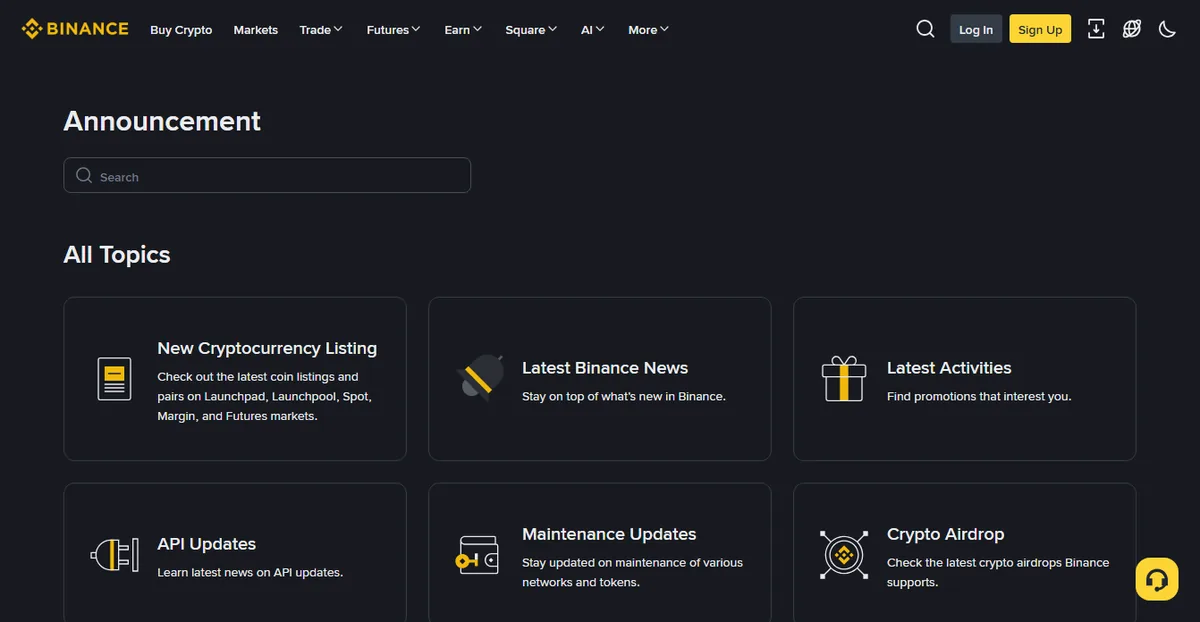
Once the dates are copied down, you can put them into the delisting timeline board, which turns them into an ordered timeline with checkpoints and days remaining. What to do over the following three days is in the first 72 hours after a delisting notice.
Risk notice: wording and structure differ between platforms; this collects common correspondences and whatever your own notice says governs. Crypto prices move violently and you can lose everything you put in. Nothing here is investment advice, and some jurisdictions place additional restrictions on crypto assets, check what applies where you are.
Once it is delisted, do my coins disappear?
Usually not. Trading stopping only means you cannot buy or sell it; the balance stays in the account and the withdrawal window generally runs a while longer (Binance’s delisting FAQ gives two months from the official delisting date as the usual figure; the date in your notice governs). What does change a balance is a forced conversion clause.
Are the times in the notice my local time?
Whatever timezone that particular notice states: the Binance notice compared above is written in UTC+8, and other platforms use UTC. Check the label first, then convert to your own timezone, particularly if you intend to operate anywhere near a deadline.
It only mentions futures pairs. Should I worry about my spot balance?
A futures delisting and a spot delisting are separate events and the notice normally makes clear which it is. Read the full pair name rather than concluding from the ticker.